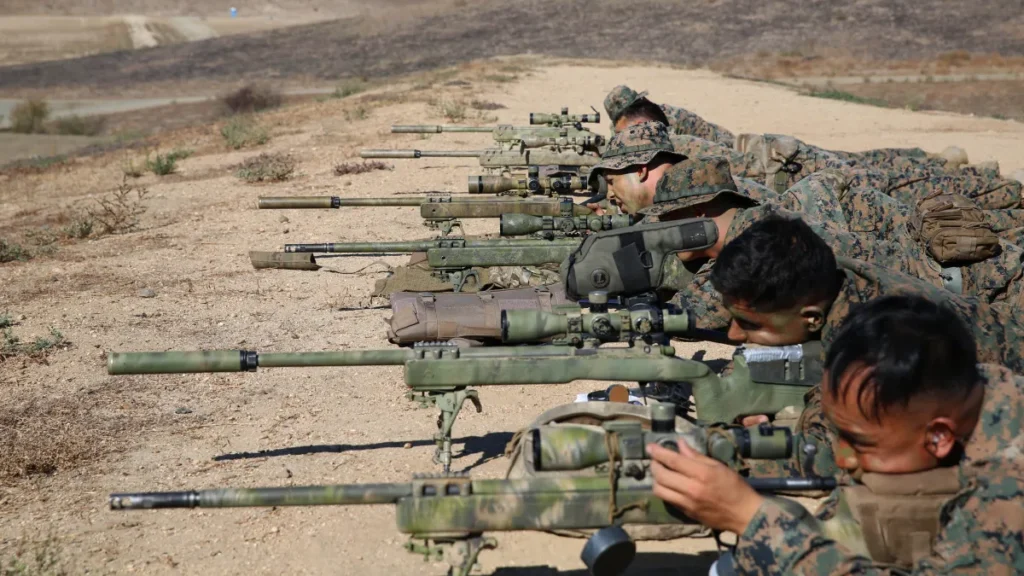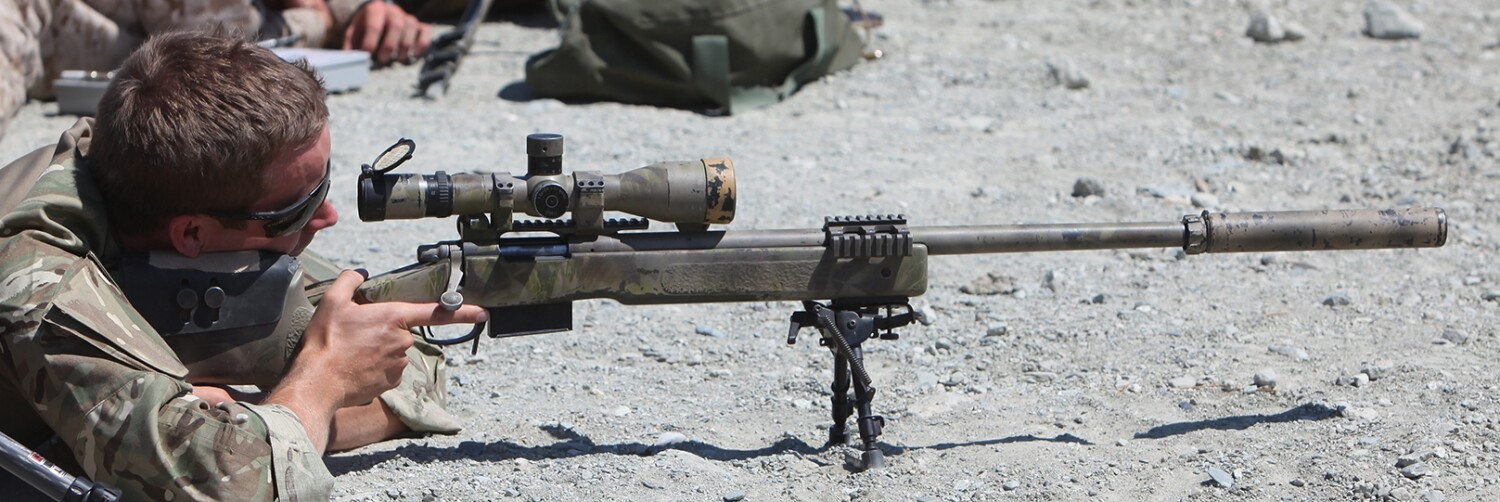
The M40 sniper rifle was developed because the United States Marine Corps entered the Vietnam War without a modern, standardized sniper rifle system suitable for widespread operational use.
Marine snipers had demonstrated their value in earlier conflicts, but the Corps lacked a single current-production rifle that could be issued consistently, supported logistically and paired with formal sniper training. Vietnam’s terrain and combat conditions made that capability increasingly important.
The solution was the M40, a bolt-action precision rifle based on Remington’s Model 40X and Model 700 family.
The Need for Snipers in Vietnam
Combat in Vietnam often involved dense vegetation, concealed movement and targets that were difficult for ordinary infantry units to identify and engage.
A trained sniper team could perform several important roles:
- Observe terrain and enemy activity
- Report movement and positions
- Engage selected targets precisely
- Reduce unnecessary ammunition expenditure
- Support infantry patrols from concealed positions
- Influence enemy behaviour over a large area
To perform those duties effectively, Marines needed a rifle that offered greater accuracy and better optics than a standard service rifle.
The Absence of a Standard Modern Rifle
At the beginning of increased American involvement in Vietnam, sniper rifles were not uniformly standardized across the Marine Corps. Some equipment dated from earlier wars, while other rifles were assembled or selected locally.
This created problems involving training, maintenance, spare parts and consistent performance.
A standardized rifle would allow the Marine Corps to:
- Establish a common sniper qualification program
- Train armourers on one platform
- Issue common optics and ammunition
- Maintain predictable accuracy standards
- Simplify replacement parts and repairs
The procurement of the M40 was therefore part of a broader effort to turn sniping into a formal and sustainable military capability.
Why Remington’s Rifle Was Selected
The Marine Corps evaluated possible rifle platforms and selected a target-oriented Remington bolt-action design.
The Model 40X was closely related to the Remington Model 700, which had been introduced commercially in the early 1960s. The action was strong, relatively simple and capable of excellent accuracy.
A commercial target rifle also offered a faster path to service than developing an entirely new military action. Remington already had the manufacturing knowledge and production capacity required to supply the rifles.
The initial Marine Corps order consisted of approximately 700 rifles, which were designated M40 after adoption in 1966.
Why a Bolt-Action Rifle?
By the 1960s, semi-automatic service rifles were already common. However, a bolt-action rifle remained highly suitable for deliberate precision fire.
Its advantages included:
- A rigid receiver
- Simple mechanical operation
- Strong accuracy potential
- Ease of inspection
- Dependable extraction and feeding
- Limited disturbance during carefully aimed shooting
The M40 was not intended to replace the standard infantry rifle. It was a specialized tool for trained snipers whose priority was precise first-round placement rather than rapid fire.
The Importance of a Telescopic Sight
The original M40 was generally issued with a Redfield 3–9× variable-power optic. This gave Marine snipers better target identification and aiming capability than iron sights could provide at extended distances.
The variable magnification allowed the shooter to select a wider field of view at lower power or greater target detail at higher power.
Although later M40 versions received more durable and sophisticated optics, the Redfield scope was an important part of the original rifle’s capability. The M40 was already being treated as more than a bare firearm: the rifle and optic were expected to function together as a precision system.
Environmental Lessons From Vietnam
Vietnam exposed an important weakness in the original M40: its wooden stock.
Wood can absorb moisture and respond to changes in humidity and temperature. If the stock shifts or applies changing pressure to the barrel and receiver, the rifle’s point of impact may also change.
This did not invalidate the original M40 concept, but it demonstrated that a military precision rifle required greater environmental stability than a traditional sporting or target rifle.
Marine armourers eventually rebuilt the rifles into the M40A1 configuration using fibreglass McMillan stocks and other upgraded components.
The rapid evolution from the M40 to the M40A1 illustrates an important principle: a rifle that performs well on a controlled range must still be adapted to survive real field conditions.
A Rifle Connected to Formal Sniper Training
The Marine Corps’ sniper capability depended on both equipment and training. An accurate rifle could not produce results without a skilled operator capable of observation, range estimation, wind reading, concealment and careful marksmanship.
The standardized M40 supported the development of consistent training methods. Students could learn on the same action, optic and ballistic system they would later use operationally.
This relationship between a standardized rifle and a standardized training program helped the Marine Corps establish one of the best-known military sniper traditions in the world.
Did the M40 Meet the Requirement?
The original M40 was not perfect, but it successfully established the foundation the Marine Corps needed.
It provided:
- A standardized sniper rifle
- A proven commercial action
- Modern telescopic sights
- Strong precision potential
- A common platform for training
- A rifle that could be rebuilt and improved
The platform’s greatest success may be its adaptability. The same basic Remington short-action concept continued through the M40A1, M40A3, M40A5 and M40A6.
Marine Corps sources state that the M40 entered service in 1966 and remained the basis of later sniper rifles for decades.
The M40’s Lasting Influence
The M40 helped popularize a precision-rifle pattern that remains familiar today:
- Commercially derived bolt action
- Heavy barrel
- Stable synthetic stock
- Quality telescopic sight
- Match-grade ammunition
- Custom bedding and assembly
Many modern civilian target rifles follow the same broad design principles, even when they have no formal military connection.
Canadian shooters interested in M40 history can find similar design features in lawful bolt-action target rifles. Any ownership, transportation, storage or range use must comply with current Canadian law and the specific classification of the firearm.
Conclusion
The Marine Corps developed the M40 because it needed a standardized and accurate sniper rifle during the Vietnam War.
The Remington-based design could be obtained quickly, supported consistently and integrated into formal sniper training. Its bolt action provided strong accuracy potential, while its telescopic sight extended the capabilities of the trained sniper.
Although the original wooden-stocked rifle required later improvements, the basic platform proved exceptionally adaptable. The result was not only a successful Vietnam-era rifle, but the beginning of an M40 family that remained connected to Marine Corps sniping for approximately half a century.