The success of a military rifle cannot be measured only by its accuracy during testing. A truly successful service rifle must remain dependable across different conflicts, environments and generations of soldiers.
By that standard, the M24 Sniper Weapon System was highly successful.
Adopted by the United States Army in 1988, the M24 served through the end of the Cold War, the Gulf War, operations in the Balkans, Afghanistan, Iraq and numerous training and security missions. It remained the Army’s standard sniper rifle through 2010, and upgraded versions of the system continued serving after that date.
Its long service history shows that the M24 did more than replace the M21. It helped rebuild Army sniper capability, supported the growth of modern sniper training and provided a foundation for future precision-rifle systems.
Early Service and the Gulf War
The M24 entered Army service shortly before the United States became involved in major operations in the Middle East.
During Operations Desert Shield and Desert Storm, Army sniper teams deployed with the new rifle. The open terrain of Iraq and Kuwait gave trained snipers opportunities to use the M24’s accuracy and observation capability at distances beyond ordinary infantry engagements.
An Army historical review later stated that the open terrain demonstrated the value of long-range engagement with the M24.
This was an important early test. The rifle had been designed during peacetime, but it quickly demonstrated practical value in an operational environment.
Supporting the Sniper Team’s Wider Role
A sniper’s role involves much more than firing a rifle. Sniper teams conduct observation, reconnaissance, target identification and reporting. Their optical equipment and fieldcraft can provide commanders with detailed information about terrain and enemy activity.
The M24 supported this role by giving the team a dependable precision capability when engagement became necessary.
The rifle’s accuracy allowed snipers to operate at greater distances than conventional riflemen. Army testing later described the M24 as capable of engaging personnel targets at approximately 800 metres under appropriate conditions.
This extended reach allowed a small sniper team to influence movement and activity across a large area.
Afghanistan and Iraq
The M24 became especially well known during U.S. operations in Afghanistan and Iraq.
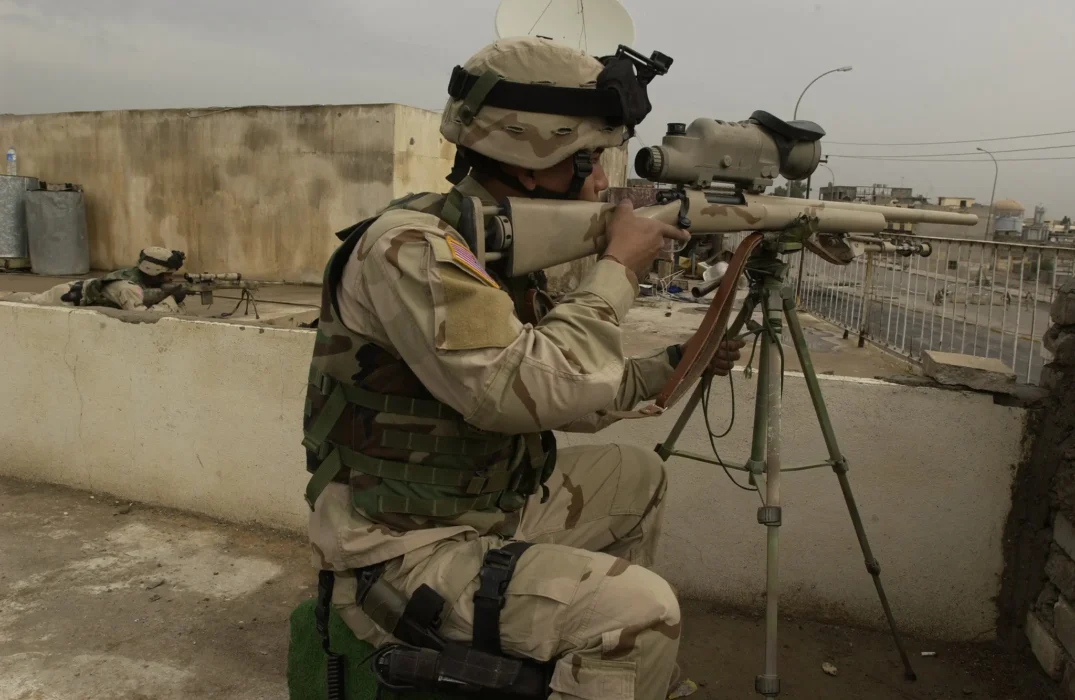
Afghanistan presented long sight lines, mountainous terrain and difficult wind conditions. Iraq combined open desert, agricultural areas and dense urban environments. In both theatres, sniper teams required rifles that could tolerate dust, temperature changes and prolonged field use.
The M24’s simple bolt action, durable synthetic stock and proven barrel system made it suitable for these demanding conditions.
Its 7.62×51mm NATO chambering was effective within the rifle’s designed range, although combat experience also revealed the need for additional systems with greater reach and faster follow-up capability.
That requirement did not make the M24 unsuccessful. Instead, it showed that no single rifle could perform every sniper mission.
The M24 and the M110
During the 2000s, the Army began fielding the M110 Semi-Automatic Sniper System. The M110 offered quicker follow-up shots and a detachable magazine, making it particularly useful when multiple targets or rapid re-engagement were expected.
An Army report from Afghanistan emphasized that the XM110’s semi-automatic action improved the ability to re-engage targets rapidly.
The M110 did not immediately eliminate the M24. For a period, both systems served because they offered different advantages.
The M24 remained a dependable bolt-action precision rifle. The M110 provided speed and greater magazine capacity. Together, they demonstrated how military sniper equipment was becoming more specialized.
Training and First-Round Accuracy
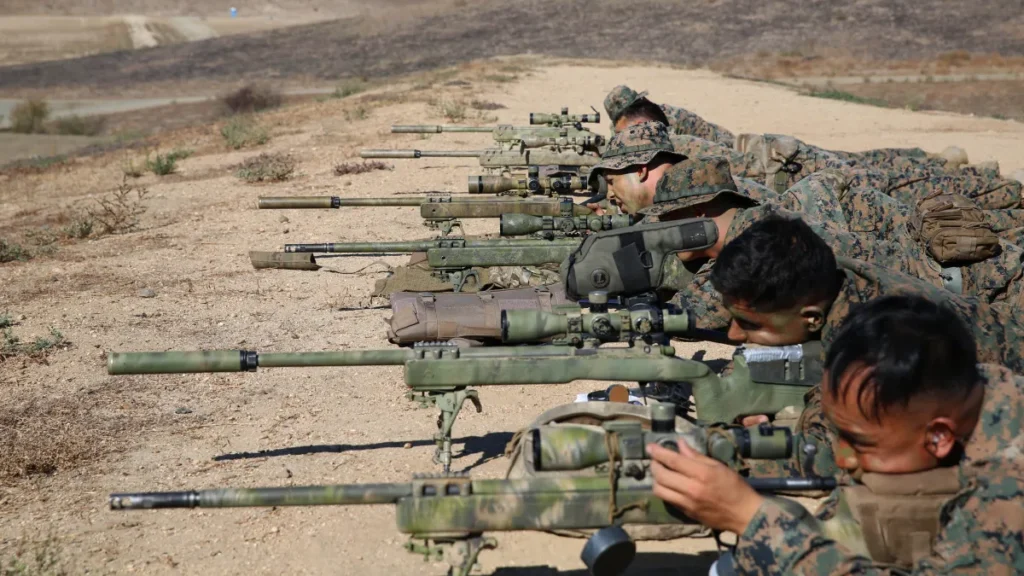
The M24 also played an important role in Army sniper training. It became one of the primary rifles used to teach range estimation, observation, wind reading, position building and precision marksmanship.
A 2012 Army report stated that graduates of the Army Sniper School were expected to achieve a 90-percent first-round hit rate at 600 metres using the M24 or M110 systems.
That figure illustrates the relationship between the rifle and the trained shooter. The M24’s consistency allowed instructors to establish a demanding and measurable performance standard.
A precision rifle cannot replace training, but a predictable rifle allows a trained sniper to apply skills with confidence.
Reliability and Maintainability
One reason the M24 remained in service for so long was its mechanical simplicity.
The bolt action had relatively few moving components compared with a gas-operated semi-automatic rifle. The synthetic stock resisted many environmental effects that could influence traditional wooden stocks, while the heavy barrel provided long-term consistency.
The rifle could also be inspected, maintained and repaired by trained armourers using an established military support system.
These qualities were essential for a rifle that might remain in inventory for decades.
Limitations Revealed by Combat
A fair assessment of the M24 must also acknowledge its limitations.
The original 7.62mm system was optimized for engagements within a specific range envelope. Afghanistan’s mountainous terrain sometimes required greater reach and retained energy. The internal magazine and manually operated bolt also limited the speed of follow-up shots compared with newer semi-automatic systems.
By 2009, Army evaluators were examining rifles intended to fill the capability gap between the M24 and larger .50-calibre systems.
These limitations did not represent a failure of the original design. The M24 had been developed according to 1980s requirements. More than two decades later, new battlefield conditions naturally produced new requirements.
Transformation Into the M2010
The most significant continuation of the M24 program was the M2010 Enhanced Sniper Rifle.
Instead of building an entirely unrelated system, the Army converted M24 rifles into a substantially upgraded platform chambered in .300 Winchester Magnum. The Army states that the M2010 was a fully upgraded M24 system and provided precision capability at ranges approximately 50 percent farther than the earlier 7.62mm sniper systems.
The M2010 program demonstrates the adaptability of the original M24 receiver. A rifle adopted in the 1980s could be rebuilt to meet the operational requirements of the 2010s.
The Army completed production of approximately 2,520 M2010 systems in 2014.
Continued Use After Replacement Began
The introduction of newer systems did not cause every M24 to disappear immediately.
Army material documented continued M24 use in training and reserve activities years after the M2010 and M110 had entered service. U.S. Army Reserve personnel were still using the M24 during a marksmanship event in 2018.
The long transition reflected the size of the Army’s inventory and the continued usefulness of the rifle for training and selected roles.
It also demonstrated that “replacement” in military service is usually gradual. New and old systems frequently overlap for many years.
International Influence
The M24 also gained international recognition. Remington states that the rifle continued to serve with armed forces around the world after its period as the U.S. Army’s standard sniper rifle.
Its international use helped establish the Model 700-based military precision rifle as one of the most familiar sniper platforms of the late twentieth and early twenty-first centuries.
The M24’s layout also influenced the expectations of civilian precision-rifle buyers. Heavy barrels, synthetic stocks, adjustable ergonomics and high-quality optics became increasingly common in commercial target rifles.
Did the M24 Achieve Its Purpose?
The M24 achieved the main goals established for it.
It replaced the M21 as the Army’s standard sniper rifle, gave sniper teams a complete and standardized weapon system, supported formal training and remained effective across multiple major conflicts.
Its service record included:
- More than two decades as the Army’s standard sniper rifle
- Operational use in desert, mountain and urban environments
- Integration into Army sniper training
- Continued use alongside newer systems
- International adoption
- Successful conversion into the M2010 platform
Very few military rifles remain relevant for so long without substantial evidence of sound design.
The M24’s Place in Firearms History
Today, the M24 is remembered as one of the defining bolt-action sniper rifles of its era.
It arrived at a time when the Army was rebuilding sniper doctrine and training. It then served through a period of major change in military technology, from fixed-power optics and traditional stocks to advanced optics and modular chassis systems.
The M24 therefore connects two generations of precision rifles. It retained the traditional strengths of a manually operated bolt action while providing the foundation for later modernization.
For Canadian firearms enthusiasts, the M24 is relevant primarily as a subject of military history, firearm collecting and precision-rifle development. Civilian rifles influenced by the Model 700 and M24 tradition may be used for lawful target shooting when owners comply with all Canadian licensing, classification, storage and transportation requirements.
Conclusion
The M24 was a successful sniper weapon system because it delivered accuracy, reliability and standardization when the U.S. Army needed to rebuild its sniper capability.
It proved its value during the Gulf War, remained active through Afghanistan and Iraq, supported generations of sniper students and was adaptable enough to become the foundation of the M2010 Enhanced Sniper Rifle.
Newer rifles eventually offered greater range, faster follow-up shots and more modular designs. However, those developments do not diminish the M24’s achievement.
Its long service life, combat record and continuing influence confirm that the M24 was not only successful—it became one of the most important military precision rifles of the modern era.