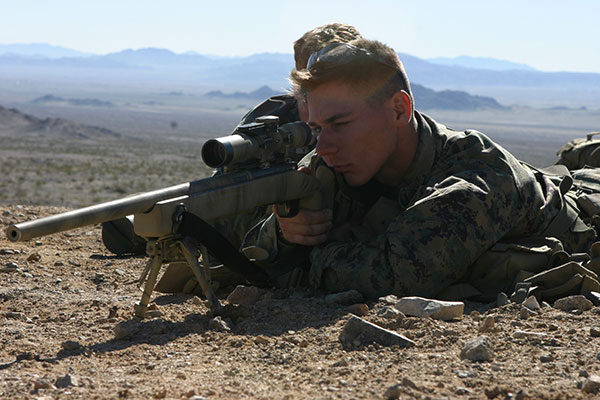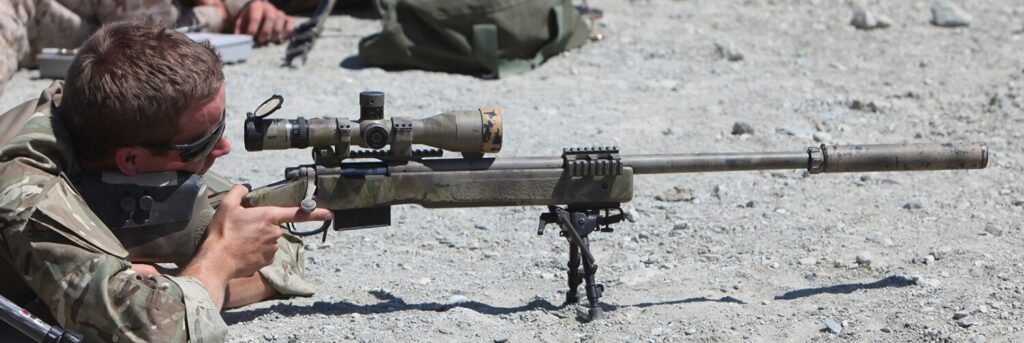
The M40A5 was an evolution of the M40A3 rather than a completely unrelated rifle. It retained the Remington Model 700 short action, Schneider barrel and McMillan A4 stock while introducing a detachable magazine, forward accessory mounting and an updated muzzle configuration.
Marine Corps precision weapons technicians assembled and maintained the rifles using components supplied by several specialist manufacturers. Among the most important were Remington, Schneider Rifle Barrels, McMillan, Badger Ordnance, Schmidt & Bender, SureFire and Harris Engineering.
As with the M40A3, individual rifles could vary because of maintenance cycles, component replacement and transitional upgrades.
Remington: Model 700 Short Action
The M40A5 continued to use the Remington Model 700 short action chambered for 7.62×51mm NATO.
This preserved the core operating system of the earlier M40 variants:
- Dual-lug rotating bolt
- Manually operated action
- Cylindrical receiver
- .308-compatible bolt face
- Proven precision-rifle foundation
Marine Corps technicians prepared and fitted the action to military specifications. The completed rifle was therefore not equivalent to an ordinary commercial Model 700, despite sharing the same basic receiver design.
Schneider Rifle Barrels: Stainless Match Barrel
Schneider Rifle Barrels remained a major supplier for the M40A5.
The rifle used a heavy stainless-steel match barrel designed for accuracy and durability. Its profile and muzzle treatment distinguished it from the conventionally crowned barrel associated with standard M40A3 builds.
The muzzle was configured to accept the issued SureFire muzzle brake. The Schneider barrel contributed:
- Match-grade accuracy potential
- Stable performance during extended firing
- Suitable rifling for military 7.62mm ammunition
- Strong service life
- Compatibility with the revised M40A5 muzzle assembly
McMillan: A4 Tactical Stock
Despite the M40A5 designation, the rifle generally retained a specialized McMillan A4 Tactical stock rather than using the commercial McMillan A5 stock.
This detail sometimes causes confusion among collectors and replica builders.
The military M40A5 A4 stock was inlet to accommodate the rifle’s updated bottom metal and forward accessory mounting system. Its principal features included:
- Vertical pistol grip
- Adjustable cheekpiece
- Spacer-based length-of-pull adjustment
- Wide and stable fore-end
- Reinforced fibreglass construction
- Sling and bipod attachment points
The stock provided a stable bedding platform while allowing the rifle to be adjusted for different shooters, clothing and field positions.
Badger Ordnance: M5 Detachable-Magazine System
One of the most important M40A5 upgrades was the Badger Ordnance M5 detachable-magazine bottom metal.
The earlier M40A3 generally began with an internal magazine. The Badger M5 system allowed the M40A5 to use detachable box magazines.
This provided several operational improvements:
- Faster loading
- Easier unloading
- More efficient ammunition changes
- Better access during malfunction clearance
- Increased ammunition capacity compared with the original internal system, depending on the issued magazine
The detachable magazine is one of the easiest visual and functional ways to distinguish a typical M40A5 from an original M40A3 configuration.
Badger Ordnance was also associated with scope bases, rings and other precision mounting hardware used on M40-series rifles.
Forward Optical and Accessory Rail
The M40A5 incorporated a forward-mounted optical platform ahead of the day scope.
This allowed compatible military observation and night-vision equipment to be positioned in line with the primary optic. The shooter could add mission-specific equipment without removing the day scope or significantly changing the rifle’s established zero.
Depending on production period and documentation, the forward rail may be associated with Precision Reflex, Pacific Tool and Gauge, PGW-pattern hardware or other contract suppliers.
The rail system was a major functional improvement because it expanded the rifle’s capability without replacing the core action, stock and barrel assembly.
Schmidt & Bender: 3–12×50 PM II Optic
The Schmidt & Bender 3–12×50 Police Marksman II became the principal modern day optic associated with the M40A5.
Compared with earlier fixed 10× scopes, it provided:
- Variable magnification
- Wider field of view at lower power
- Greater target detail at higher power
- High-quality optical glass
- Precise elevation and windage controls
- Adjustable parallax
- Improved low-light performance
The optic formed part of the Scout Sniper Day Scope system and represented a major improvement in flexibility over the older Unertl MST-100.
Its mounting system generally used robust precision rings and a receiver-mounted rail, with Badger Ordnance commonly associated with the relevant M40-series hardware.
SureFire: Muzzle Brake
SureFire supplied the muzzle brake used on the M40A5.
A muzzle brake redirects propellant gases to reduce felt recoil and muzzle movement. On a heavy 7.62mm precision rifle, this can help the shooter remain in position and observe impacts through the optic.
The brake also formed part of the rifle’s revised muzzle system and distinguished the A5 barrel configuration from the conventional muzzle of many earlier M40A3 rifles.
Harris Engineering: Bipod
The M40A5 commonly used a Harris bipod or a military version based on the Harris design.
Its folding, adjustable legs supported prone and field shooting positions while keeping the system relatively portable.
The bipod remained popular because it was:
- Mechanically simple
- Relatively lightweight
- Quickly deployable
- Adjustable for uneven terrain
- Compatible with the McMillan stock
A rear support bag could also be used during controlled precision shooting, although it was not permanently attached to the rifle.
Trigger Components
The M40A5 retained a tuned Remington-pattern trigger assembly prepared to meet Marine Corps specifications.
The trigger was adjusted and inspected by qualified personnel to provide a consistent and controlled release. Reliability, safety and repeatability were more important than achieving the lightest possible trigger pull.
The final trigger specification worked together with the bedded action and heavy barrel to support dependable first-round accuracy.
Sling and Carrying Equipment
The McMillan stock included sling mounting points, and the issued rifle system could include a tactical or shooting-support sling.
A proper sling helped distribute the weight of the rifle and could provide additional stability in field positions.
The complete weapon system also included items such as:
- Hard transport case
- Soft carrying case
- Cleaning equipment
- Maintenance tools
- Scope accessories
- Technical documentation
- Spare and support components
The M40A5 was therefore issued and maintained as a complete sniper weapon system rather than only as a rifle.
Marine Corps Precision Weapons Section: System Integration
The final M40A5 was assembled by Marine Corps precision weapons technicians, historically associated with the Precision Weapons Section at Quantico.
Their work included:
- Inspecting and preparing receivers
- Installing and chambering barrels
- Bedding actions into stocks
- Fitting bottom metal and magazines
- Installing forward rails
- Mounting optics
- Adjusting triggers
- Performing function testing
- Conducting accuracy testing
- Rebuilding rifles during scheduled maintenance
This final integration was essential. Premium components alone do not guarantee the accuracy, durability or reliability of a completed precision rifle.
The M40A5’s performance depended on the relationship between its components and the skill of the technicians who fitted them together.
M40A5 Component Summary
| Component | Main Supplier |
|---|---|
| Receiver and bolt | Remington |
| Barrel | Schneider Rifle Barrels |
| Stock | McMillan |
| Detachable-magazine system | Badger Ordnance |
| Scope base and rings | Badger Ordnance or contract-specified supplier |
| Day optic | Schmidt & Bender |
| Muzzle brake | SureFire |
| Forward optical rail | Contract-dependent supplier |
| Bipod | Harris Engineering |
| Final assembly | USMC Precision Weapons Section |
How the M40A5 Differed From the M40A3
The M40A5’s principal improvements were practical rather than cosmetic.
Compared with a standard early M40A3, the A5 added:
- Detachable box magazine
- Revised bottom metal
- Forward optical platform
- Updated muzzle and brake
- Improved support for modern optics
- Operational refinements based on combat experience
The action, stock design, cartridge and basic barrel concept remained closely related to the M40A3.
The M40A5 therefore preserved the proven foundation of the earlier rifle while improving loading, equipment integration and overall operational flexibility.
Configuration Variations
Not every M40A5 was completely identical throughout its service life.
Individual rifles could receive:
- Replacement barrels
- Updated optics
- Different scope rings or bases
- New magazines
- Replacement stocks
- Revised rail components
- Refurbished trigger assemblies
Contract suppliers could also change over time. For that reason, identifying a specific rifle accurately may require examining its service period, markings and documented maintenance history.
Historical Replica Considerations
Commercial rifles inspired by the M40A5 may reproduce its general appearance and component layout, but they should not automatically be described as genuine Marine Corps M40A5 rifles.
A historically detailed replica may attempt to match:
- The Remington short action
- Schneider-style heavy barrel
- McMillan A4 stock
- Badger M5 bottom metal
- Schmidt & Bender optic
- SureFire muzzle brake
- Harris bipod
- Correct mounting hardware
However, the original rifles were assembled, inspected and tested by Marine Corps precision weapons technicians. That institutional build process is part of what defined an authentic M40A5.
Conclusion
The M40A5 combined a Remington action, Schneider barrel, McMillan A4 stock, Badger Ordnance detachable-magazine system, Schmidt & Bender optic, SureFire muzzle brake and Harris bipod.
Marine Corps precision weapons technicians fitted those components into a complete military system designed around accuracy, durability and operational flexibility.
The M40A5 succeeded because it preserved the trusted qualities of the M40A3 while addressing practical limitations identified during modern deployments. Its detachable magazine, updated optic and expanded mounting capability made it the most refined conventional-stock version of the M40 family.