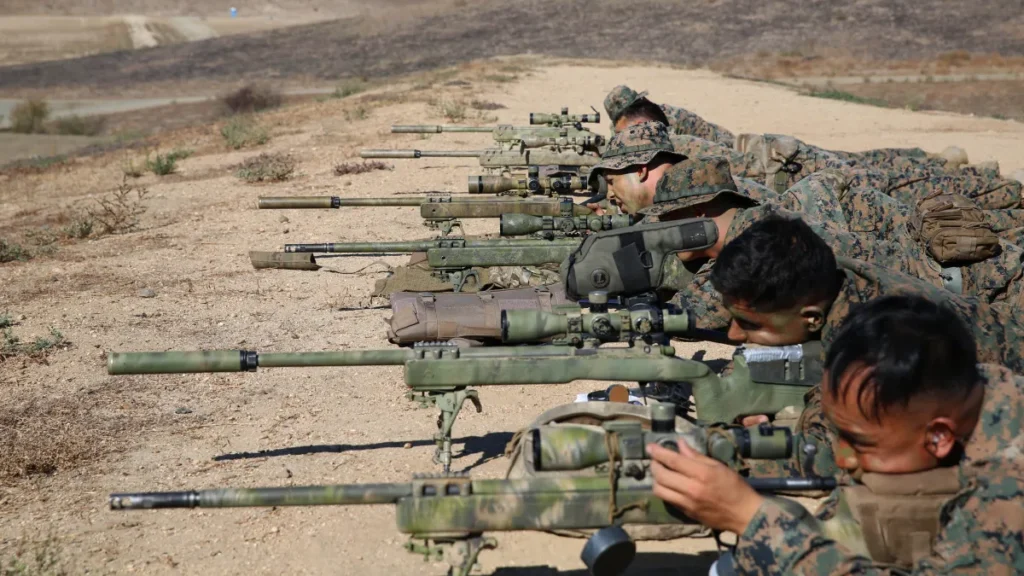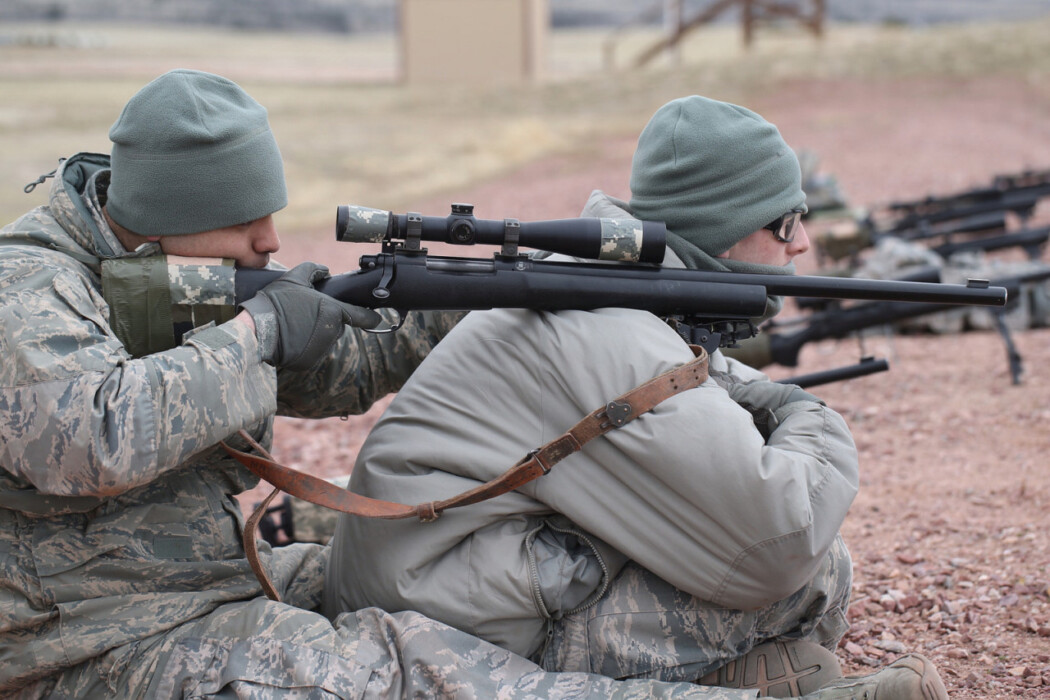
The M24 Sniper Weapon System became the standard bolt-action sniper rifle of the United States Army in 1988. Its development brought together an established commercial action, military accuracy requirements, specialized testing and a complete package of optics and support equipment.
Although the finished M24 appeared straightforward, its development required careful decisions about the action, barrel, stock, trigger, optic and long-term military role of the rifle.
The result was a precision system that combined familiar mechanical principles with components selected specifically for military service.
The Army’s Search for a New Sniper System
In the mid-1980s, the Army began pursuing a replacement for the M21 Sniper Weapon System. The M21 had served since the Vietnam era, but the Army wanted a purpose-built system that could support renewed sniper training and meet future operational needs.
Development work began after the U.S. government requested proposals for a new sniper rifle system. Remington responded with a design based on the Model 700 bolt-action rifle.
A contemporary account of the program states that the government request was made in 1986, Remington produced an initial test rifle within approximately 45 days and the company received the production contract in 1987. The Army formally adopted the system as the M24, with fielding beginning in 1988.
Building on the Remington Model 700
The Model 700 was a logical starting point because it was already a proven bolt-action platform. It had been in commercial production since 1962 and had developed a reputation for accuracy, receiver strength and adaptability.
However, the M24 was not simply a standard commercial Model 700 fitted with an optic. The rifle was manufactured to military specifications and assembled as part of a complete system.
The action, barrel, stock and trigger had to work together consistently. Each component also had to withstand military handling and environmental exposure.
The adopted rifle used a long-action receiver even though the original service chambering was 7.62×51mm NATO. This feature later became important because the M24 platform could be rebuilt around the longer .300 Winchester Magnum cartridge during the M2010 upgrade program. The Army describes the M2010 as a fully upgraded and rechambered M24 system.
Prototype Testing and the Army Marksmanship Unit
The U.S. Army Marksmanship Unit played an important role in developing and evaluating military precision rifles. Its Custom Firearms Shop had experience with both the M21 and M24 systems.
Army accounts credit the unit with research, development and testing that improved the accuracy and reliability of Army weapons. One Army profile states that a team supervised the testing and evaluation of 16 M24 prototypes.
Prototype testing was essential because a military sniper rifle had to meet more than an accuracy requirement. Evaluators also had to consider reliability, durability, ergonomics, maintenance and the ability of the complete system to remain consistent in field conditions.
The Heavy Stainless-Steel Barrel
One of the M24’s defining components was its heavy, free-floating stainless-steel barrel. A heavy barrel helps maintain stability and can reduce changes in point of impact as the barrel heats during firing.
The free-floating arrangement prevents the stock from applying inconsistent pressure to the barrel. This supports repeatable harmonics and helps the rifle maintain accuracy despite changes in shooting position or environmental conditions.
The barrel also used 5R rifling, a design associated with Remington precision barrels. The lands and grooves were shaped to reduce sharp opposing contact points on the bullet while maintaining consistent engagement.
For the Army, the important result was a durable barrel capable of meeting military accuracy standards over a long service life.
The Reinforced Synthetic Stock
Traditional wood stocks can respond to moisture and temperature changes. For a military rifle expected to serve in many climates, dimensional stability was extremely important.
The M24 therefore used a reinforced synthetic stock manufactured by H-S Precision. Its internal structure provided a stable bedding surface for the receiver while resisting environmental changes better than a conventional wooden stock.
The stock also included an adjustable length-of-pull system. This allowed the rifle to fit different shooters and accommodate variations in clothing and equipment.
Although adjustable stocks are common on modern precision rifles, the M24’s stock was an advanced and practical feature for its era.
The Trigger and Manual Operation
The M24 used a manually operated bolt action with an adjustable trigger. A clean and predictable trigger is essential for precision shooting because excessive weight, roughness or inconsistent movement can disturb the shooter’s aim.
The bolt action emphasized deliberate operation and mechanical simplicity. The sniper manually lifted and cycled the bolt after each shot, ejecting the fired case and loading the next cartridge.
This arrangement did not provide the rapid follow-up capability of a semi-automatic rifle, but it offered a rigid platform with strong precision potential.
The Leupold Fixed-Power Optic
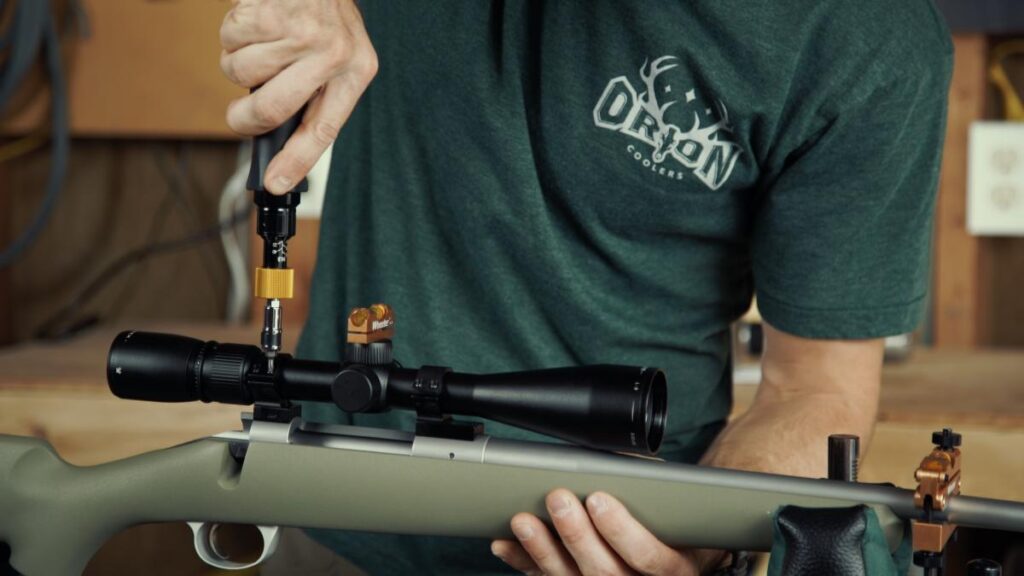
The original M24 system was commonly associated with the Leupold Ultra M3A 10-power telescopic sight. A fixed-power optic offered simplicity and durability while providing enough magnification for observation and precision fire at the rifle’s intended distances.
The optic included elevation adjustments designed to help the shooter compensate for range. Combined with military ammunition and structured sniper training, it formed an integrated sighting system rather than an unrelated commercial accessory.
A National Firearms Museum description of an issued M24 identifies its Remington 5R barrel and Leupold M3 day optic as key parts of the original system.
Why It Was Called a Weapon System
The official designation was M24 Sniper Weapon System, not simply M24 rifle.
The package included:
- The bolt-action rifle
- Telescopic sight
- Bipod
- Sling
- Iron sights or supporting sight equipment, depending on configuration
- Cleaning and maintenance tools
- Spare components
- Protective carrying cases
Issuing these components together helped ensure that sniper teams received a standardized operational package. It also simplified training, maintenance and replacement procedures.
This concept became increasingly important in modern military procurement. The accuracy of a precision rifle depends on the relationship between the firearm, optic, mount, ammunition and trained user.
Chambering and Ammunition
The original M24 was chambered for 7.62×51mm NATO ammunition. This allowed the rifle to use a cartridge already established within military logistics.
Specialized match ammunition improved consistency for precision use. Over time, the M118 family of ammunition became closely associated with American military sniper rifles.
The 7.62mm chambering gave the M24 a practical balance of accuracy, recoil, ammunition availability and barrel life. It also made the rifle suitable for the engagement distances expected when it entered service.
Adoption and Initial Fielding
The Army began fielding the M24 in 1988. An Army publication from early that year stated that the M21 would soon be replaced by the M24 and that initial fielding was scheduled to begin in April.
Remington’s own historical timeline states that production began in 1988 and that the M24 remained the U.S. Army’s standard sniper rifle through 2010.
The completed system gave Army sniper teams a modern bolt-action rifle just before a period of major overseas operations.
A Design With Long-Term Upgrade Potential
One of the strongest signs of the M24’s design quality was its ability to accept major upgrades years later.
When the Army required greater range and energy, many M24 rifles were converted into the M2010 Enhanced Sniper Rifle. The conversion included a new chambering, barrel, stock system, magazines and optic.
The Army reported that 2,520 M2010 systems were produced to replace 7.62mm M24 rifles.
Rather than discarding every M24 receiver, the Army was able to rebuild the existing platform into a substantially more capable system. That upgrade path demonstrated the strength and adaptability of the original action.
Influence on Civilian Precision Rifles
The M24 helped establish a visual and mechanical pattern that remains influential in civilian precision rifles: a proven bolt action, heavy free-floating barrel, synthetic stock, adjustable fit and quality telescopic sight.
For Canadian target shooters and collectors, the M24 is historically relevant because of its connection to the Remington Model 700 family and the broader development of modern precision-rifle design.
Commercial rifles should not be confused with issued military M24 systems, even when they share similar features or styling. Any firearm owned or used in Canada must comply with current Canadian licensing, classification, storage and transportation laws.
Conclusion
The M24 development program succeeded because it combined proven technology with focused military engineering.
Remington supplied the Model 700-based action and production capability. The Army Marksmanship Unit contributed precision-rifle expertise and prototype evaluation. Specialized components created a stable, durable and accurate complete system.
Adopted in 1988, the M24 would remain in service for decades and later provide the foundation for the M2010 upgrade. Its development demonstrated that a carefully integrated rifle system could offer both immediate performance and long-term adaptability.