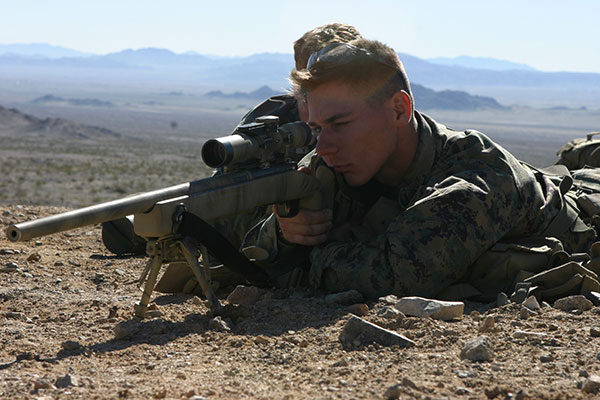
The M40A3 was not a conventional production rifle purchased complete from a single commercial manufacturer. It was a specialized Marine Corps sniper weapon system assembled by trained precision weapons technicians using a Remington action and selected components from several respected manufacturers.
That construction method is one of the most interesting features of the M40 program. Remington provided the foundation, but companies including Schneider Rifle Barrels, McMillan Fiberglass Stocks, D.D. Ross, Badger Ordnance and Schmidt & Bender contributed important components during different stages of the A3’s service life.
Because the M40A3 configuration changed over time, there is no single component list that accurately describes every rifle ever designated M40A3. Early, transitional and late examples may differ, particularly in their optics and bottom metal.
Remington: Model 700 Short Action
The central component of the M40A3 was the Remington Model 700 short action with a .308-compatible bolt face.
The Model 700 action provided:
- A cylindrical receiver suitable for precision bedding
- Dual front locking lugs
- A recessed bolt face
- A reliable manually operated action
- Strong aftermarket and armourer support
Marine Corps precision weapons technicians inspected, prepared and fitted the action rather than simply installing an untouched commercial receiver into a stock.
The use of the short action maintained continuity with earlier M40 rifles and kept the system compatible with the 7.62×51mm NATO cartridge.
Schneider Rifle Barrels: Match-Grade Stainless Barrel
The M40A3 is strongly associated with Schneider Rifle Barrels.
The rifle generally used a heavy Schneider match-grade stainless-steel barrel built to the Marine Corps specification. The barrel employed a right-hand twist appropriate for the military’s 7.62mm match ammunition and a heavy profile intended to support consistency during precision shooting.
The heavy barrel offered several advantages:
- Resistance to rapid heating
- Stable barrel harmonics
- Reduced movement during firing
- Long-term accuracy potential
- A rigid platform for match ammunition
The M40A3 barrel originally ended in a conventional precision crown rather than the later M40A5 muzzle configuration.
McMillan: A4 Tactical Stock
McMillan Fiberglass Stocks supplied one of the most recognizable components of the M40A3: the A4 Tactical stock.
The McMillan A4 featured:
- A vertical-style pistol grip
- Wide fore-end
- Adjustable cheek support
- Spacer-adjustable length of pull
- Multiple sling attachment points
- Reinforced fibreglass construction
The A4 represented a major ergonomic improvement over the earlier M40A1 stock. It supported a more upright trigger-hand position and allowed the shooter to establish a repeatable cheek weld behind the optic.
McMillan confirms that specialized M40A3 and M40A5 versions of its stocks were produced for rifles following the Marine Corps configurations.
The fibreglass construction also resisted environmental changes better than traditional wood.
D.D. Ross: Early Bottom Metal and Related Hardware
Many early M40A3 rifles used a D.D. Ross trigger guard and internal-magazine floorplate assembly.
This assembly preserved the traditional five-round internal magazine arrangement. Cartridges were loaded through the open receiver, and the floorplate could be opened to unload the magazine.
D.D. Ross also became associated with other precision-rifle hardware used during portions of the M40A3 program, including mounting-related components and recoil-lug specifications.
Exact configurations varied because rifles were rebuilt during scheduled maintenance and upgrades. A rifle originally assembled with D.D. Ross hardware might later receive different components.
Badger Ordnance: Mounting Hardware and Later Magazine Components
Badger Ordnance supplied several components associated with later M40A3 rifles and the transition toward the M40A5.
These included:
- Scope rings
- Scope-mounting bases
- Recoil-lug or mounting-related hardware on applicable builds
- M5 detachable-magazine bottom metal on upgraded rifles
Beginning in the later stages of M40A3 service, some rifles received Badger Ordnance M5 bottom metal. This changed the rifle from the original internal-magazine configuration to a detachable box magazine.
As a result, a late or transitional M40A3 may appear mechanically similar to an early M40A5 in certain areas.
Optics: Unertl and Schmidt & Bender
The optic fitted to an M40A3 depended heavily on its production and upgrade period.
Unertl MST-100
Early M40A3 rifles continued to use the Unertl MST-100 10× fixed-power optic associated with the late M40A1 program.
Its advantages included:
- Simple fixed magnification
- Durable construction
- Familiar controls
- Established Marine Corps training and maintenance
The fixed 10× design provided adequate magnification for deliberate long-range observation and aiming, although it offered less flexibility than later variable-power optics.
Schmidt & Bender PM II
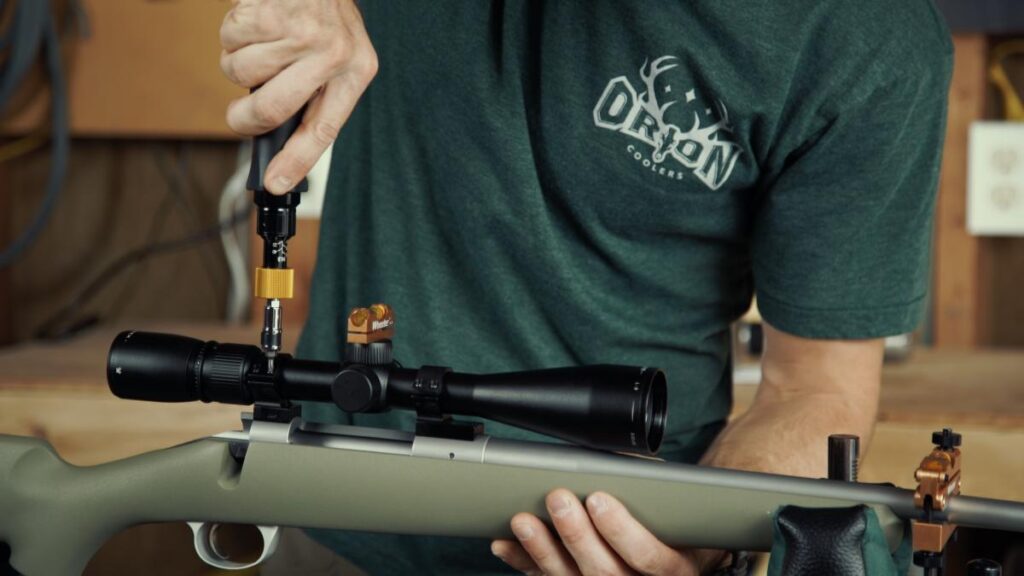
Later M40A3 systems received the Schmidt & Bender 3–12×50 Police Marksman II optic as part of the Scout Sniper Day Scope program.
The variable magnification gave the shooter:
- A wider field of view at lower power
- Greater target detail at higher power
- Improved optical performance
- Modern elevation and windage adjustment
- Better adaptability across engagement distances
Some references treat the Schmidt & Bender optic primarily as an M40A5 component, but transitional A3 rifles could also receive updated day optics during their service lives.
Harris Engineering: Bipod
M40A3 systems commonly used a Harris bipod or a military-specified version of the familiar Harris design.
The bipod provided a portable front support that could be deployed quickly from prone and supported positions. Its folding legs allowed it to remain attached to the rifle during transport.
The bipod was not simply a convenience. A stable front support helped the shooter maintain alignment and observe impacts during precision fire.
Sling and Attachment Hardware
The M40A3 stock included multiple attachment points for carrying and shooting-support slings. Flush-mounted cups and conventional studs could be present depending on the stock generation and system configuration.
The sling helped with:
- Carrying the heavy rifle
- Building supported field positions
- Stabilizing the shooter
- Securing the rifle during movement
The complete system also included maintenance equipment, protective cases and other issued accessories.
Marine Corps Precision Weapons Technicians: Final Assembly
The most important “manufacturer” of the completed M40A3 was effectively the Marine Corps Precision Weapons Section at Quantico.
Its technicians performed tasks such as:
- Inspecting and preparing the action
- Fitting the barrel
- Bedding the receiver
- Installing the trigger and bottom metal
- Mounting and aligning the optic
- Function testing
- Accuracy testing
- Maintaining and rebuilding rifles
The M40A3 therefore differed from an ordinary factory rifle. It was an armourer-built military system assembled from selected commercial and military-contract components.
M40A3 Component Summary
| Component | Main Supplier |
|---|---|
| Receiver and bolt | Remington |
| Barrel | Schneider Rifle Barrels |
| Stock | McMillan |
| Early bottom metal | D.D. Ross |
| Later bottom metal and mounting parts | Badger Ordnance |
| Early optic | Unertl |
| Later optic | Schmidt & Bender |
| Bipod | Harris Engineering |
| Final assembly | USMC Precision Weapons Section |
Configuration Variations
Collectors should be cautious when describing any M40A3 configuration as universally correct.
During the rifle’s service life:
- Optics were replaced
- Barrels wore out and were renewed
- Bottom metal was upgraded
- Stocks were repaired or replaced
- Accessory rails were added
- Individual rifles passed through transitional configurations
The Marine Corps technical manual covers both the M40A3 and M40A5 because the systems shared many major assemblies.
A historically accurate discussion should therefore identify the approximate production or service period rather than treating every M40A3 as identical.
Conclusion
The M40A3 brought together a Remington Model 700 action, Schneider barrel, McMillan A4 stock and specialized components from D.D. Ross, Badger Ordnance, Unertl, Schmidt & Bender and Harris.
Its final performance came not from one individual component, but from the way Marine Corps precision weapons technicians fitted and tested the complete system.
That combination of established manufacturers and armourer craftsmanship made the M40A3 one of the most recognizable precision rifles of the early twenty-first century.