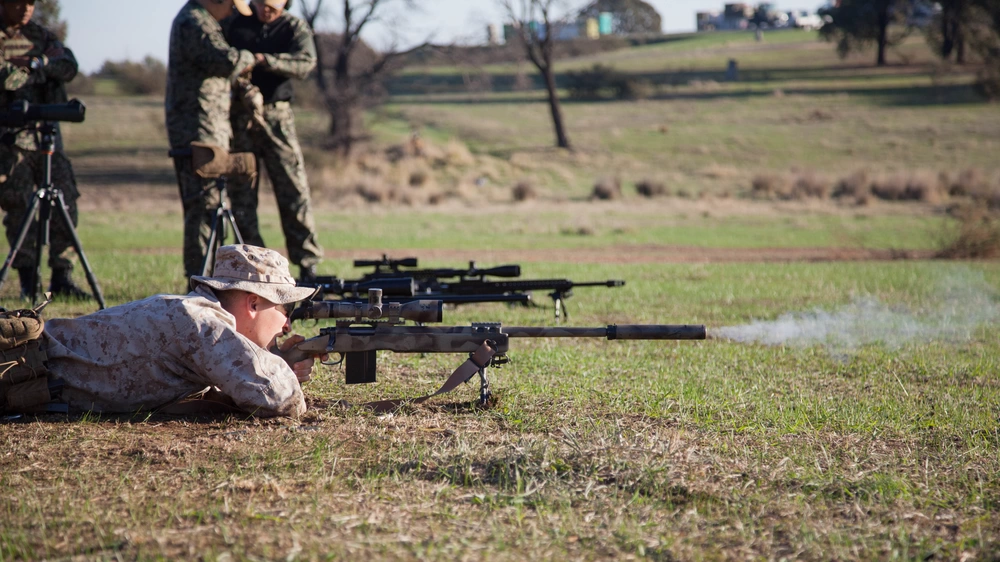
The M40 rifle family occupies an important place in the history of modern military precision rifles. First adopted by the United States Marine Corps during the Vietnam War, the M40 evolved from a relatively straightforward Remington bolt-action rifle into a highly specialized sniper weapon system assembled by Marine Corps precision weapons technicians.
Although every major version retained the Remington Model 700 short-action foundation and the 7.62×51mm NATO chambering, changes to the stock, barrel, optic, magazine system and accessory mounting capability reflected new battlefield requirements.
Understanding the differences between the M40, M40A1, M40A3, M40A5 and M40A6 also shows how precision-rifle design changed over approximately five decades.
The Original M40
The original M40 was adopted in 1966 after the Marine Corps identified a need for a standardized sniper rifle during the Vietnam War. It was based on the Remington Model 40X, a target-oriented version of the Model 700 bolt-action rifle.
Unlike later M40 variants assembled or rebuilt by Marine armourers, the first rifles were largely factory-produced by Remington. Approximately 700 rifles were initially ordered for Marine Corps service.
Important features included:
- Remington Model 700-pattern short action
- 7.62×51mm NATO chambering
- Heavy barrel
- Walnut stock
- Internal magazine
- Redfield 3–9× variable-power optic
The original M40 was accurate and gave Marine snipers a standardized precision rifle, but the wooden stock proved vulnerable to environmental changes. Moisture and temperature could cause the stock to shift or warp, potentially affecting the rifle’s bedding and point of impact.
That weakness led directly to the development of the M40A1.
The M40A1
The M40A1 was not simply a factory replacement for the original rifle. Marine Corps precision weapons technicians at Quantico rebuilt existing M40 rifles and incorporated new components intended to improve durability and accuracy.
The most important change was the replacement of the walnut stock with a fibreglass McMillan stock. The synthetic construction was more resistant to moisture and temperature changes, making it better suited to field use.
Typical M40A1 features included:
- Remington Model 700 short action
- McMillan fibreglass stock
- Heavy match-grade barrel
- Fixed internal magazine
- Unertl 10× fixed-power optic on later standard configurations
- Custom bedding and assembly by Marine armourers
The M40A1 became closely associated with the Marine Corps scout-sniper community and remained in service for decades. Its combination of a Model 700 action, heavy barrel, synthetic stock and fixed-power optic helped establish a pattern that influenced many later precision rifles.
The M40A3
Development of the M40A3 began during the 1990s as the Marine Corps sought to modernize the ageing M40A1 fleet. The A3 retained the same basic action and chambering but introduced a much more adjustable stock, a new barrel specification and updated mounting hardware.
The M40A3 used a McMillan A4 Tactical stock. Compared with the M40A1 stock, the A4 offered a more vertical pistol grip, adjustable cheek support and a spacer-based length-of-pull system. These features helped the rifle fit different shooters and supported a more consistent head position behind the optic.
Major M40A3 features included:
- Remington Model 700 short action
- Schneider match-grade stainless-steel barrel
- McMillan A4 Tactical stock
- Five-round internal magazine on early configurations
- DD Ross bottom metal on many early rifles
- Badger Ordnance components on later configurations
- Fixed or variable-power military optics, depending on production period
- Bipod and sling attachment points
- Assembly by Marine Corps precision weapons technicians
The official Marine Corps maintenance manual identifies the barrel and receiver assembly, bolt, stock, trigger guard, magazine, telescope, accessory rail, bipod and optical platform as the major assemblies of the M40A3 and M40A5.
The A3 was larger and heavier than the original M40, but it provided better ergonomics and a much more stable shooting platform.
The M40A5
The M40A5 was introduced around 2009 as an operational improvement to the M40A3. Rather than creating an entirely new rifle, the Marine Corps modified the existing A3 design to address requirements identified during operations in Afghanistan and Iraq.
The most visible changes were the detachable magazine system, forward accessory rail and revised muzzle configuration.
Important M40A5 features included:
- Remington Model 700 short action
- Schneider stainless-steel match barrel
- McMillan A4 Tactical stock
- Badger Ordnance M5 detachable-magazine bottom metal
- Detachable box magazine
- Forward optical or accessory rail
- SureFire muzzle brake on applicable configurations
- Schmidt & Bender variable-power day optic on later systems
- Harris-style bipod
- 7.62×51mm NATO chambering
The detachable magazine made loading and unloading more efficient than the A3’s original internal-magazine arrangement. The forward rail allowed compatible military observation and night-vision equipment to be positioned ahead of the day optic without disturbing the rifle’s zero.
Marine Corps sources identify the M40A5 as the latest M40 variant in service by 2016 and note that it was introduced in 2009.
The M40A5 retained the accuracy and familiar handling of the A3 while improving its operational flexibility.
The M40A6
The M40A6 represented the most significant structural modernization of the traditional M40 platform. It retained the Remington-based action and 7.62mm chambering but replaced the conventional fibreglass stock with a modular chassis.
The folding and adjustable chassis improved transportability, concealability and shooter ergonomics. Marine Corps Systems Command began fielding the M40A6 in 2016.
Major M40A6 changes included:
- Modular aluminium chassis
- Folding stock
- Adjustable cheek support
- Adjustable length of pull
- Detachable magazine
- Improved accessory mounting
- More compact transport configuration
- Continued use of the 7.62×51mm NATO cartridge
The M40A6 was substantially more adaptable than earlier versions, but it remained limited by the ballistic performance of the 7.62mm cartridge. The Marine Corps later began replacing legacy M40A6 rifles with longer-range systems, including the Mk13 Mod 7 and Mk22 Mod 0.
M40 Variant Comparison
| Version | Main Stock | Magazine | Major Improvement |
|---|---|---|---|
| M40 | Walnut | Internal | Standardized Vietnam-era sniper rifle |
| M40A1 | McMillan fibreglass | Internal | Better environmental stability |
| M40A3 | McMillan A4 | Internal on original builds | Improved ergonomics and modern components |
| M40A5 | McMillan A4 | Detachable | Faster loading and expanded accessory support |
| M40A6 | Modular chassis | Detachable | Folding design and improved adjustability |
What Stayed Consistent?
Despite multiple upgrades, the M40 family retained several core characteristics:
- Bolt-action operation
- Remington Model 700-pattern short action
- 7.62×51mm NATO chambering
- Emphasis on first-round accuracy
- Custom assembly and maintenance by trained Marine technicians
- Integration with specialized optics and field equipment
This continuity allowed Marine scout snipers to transition between versions without abandoning the basic handling and operating principles of the platform.
Why the M40 Family Matters
The M40 family demonstrates how a proven rifle can be continuously modernized. Rather than replacing the entire platform every few years, the Marine Corps upgraded stocks, barrels, optics, magazines and accessory systems as technology and operational requirements changed.
For Canadian firearm enthusiasts, the M40 is historically connected to the Remington Model 700 and the development of modern precision target rifles. Civilian rifles inspired by the M40 can be used for lawful collecting and target shooting, subject to Canadian firearm classification, licensing, storage and transportation requirements.
Military-only equipment and configurations should not be assumed to be lawful or commercially available in Canada.
Conclusion
The original M40 established a standardized Marine Corps sniper rifle during the Vietnam War. The M40A1 improved durability, the M40A3 introduced modern ergonomics, the M40A5 added a detachable magazine and expanded equipment support, and the M40A6 moved the system into a modular chassis.
Each version responded to a genuine operational requirement while preserving the reliable Remington-based action at the centre of the system.
The M40’s long development history is therefore more than a sequence of model numbers. It is a record of how military precision-rifle design evolved from wood-stocked rifles and simple variable optics to adjustable chassis systems and integrated observation equipment.