


Benefit Reloading Your Own Ammunition
For the dedicated marksman, the pursuit of precision is a journey without a finish line. While modern factory match-grade ammunition has reached impressive heights, it is still a mass-produced product designed to function “well enough” in millions of different rifles. To truly unlock the mechanical potential of a high-end firearm, one must move beyond the shelf and into the world of handloading. The primary benefit of reloading your own ammunition is the ability to achieve a level of quality, consistency, and precision that no factory line can replicate.
The Science of Harmonically Tuned Loads
Every rifle barrel possesses a unique vibrational pattern, known as harmonics, which occurs the moment a shot is fired. When you reload your own ammunition, you are not just assembling components; you are tuning a musical instrument.
Through Optimal Charge Weight (OCW) testing or ladder testing, a reloader can fine-tune the powder charge in increments as small as 0.1 grains. This allows the shooter to find the “sweet spot” where the bullet exits the muzzle at the most stable point of the barrel’s vibration. The result is a dramatic reduction in group sizes and a level of repeatability that factory ammunition—loaded to a generic median charge—simply cannot offer.
Precision Seating and “The Jump”
Factory ammunition must adhere to strict SAAMI (Sporting Arms and Ammunition Manufacturers’ Institute) specifications for Cartridge Overall Length (COAL) to ensure it fits in every magazine and chamber on the market. However, every chamber is cut with slightly different tolerances.
By reloading, you can control the seating depth of the bullet relative to your specific rifle’s rifling (the lands). Measuring the Cartridge Base to Ogive (CBTO) allows you to minimize the “jump”—the distance the bullet travels before engaging the rifling. Fine-tuning this distance can eliminate flyers and significantly improve the concentricity of the bullet as it enters the bore, ensuring a more stable flight path from the moment of ignition.
Unrivaled Consistency: Low SD and ES
In long-range precision shooting, vertical dispersion is often the result of inconsistent muzzle velocities. In the world of handloading, success is measured by Standard Deviation (SD) and Extreme Spread (ES).
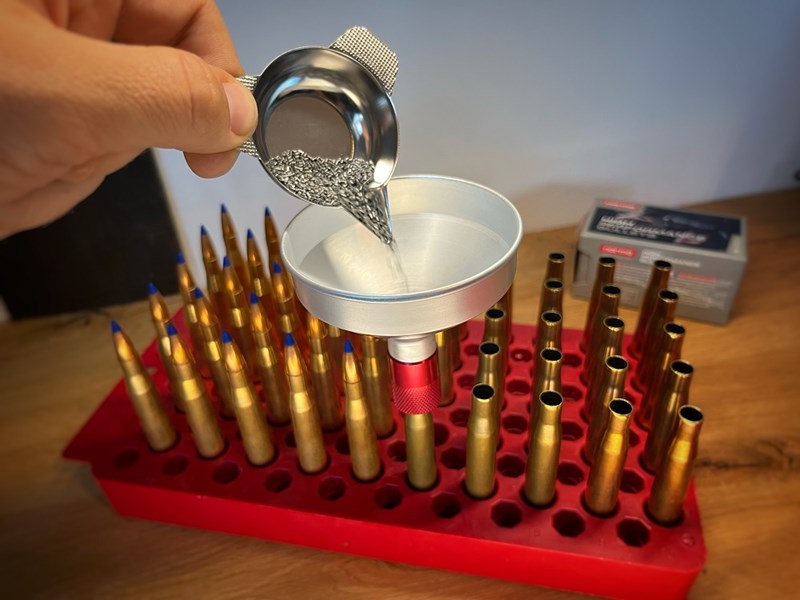
- Powder Measurement: While factory machines may have a tolerance of several tenths of a grain, a handloader can utilize high-precision digital scales to ensure every single round has an identical powder charge.
- Component Sorting: Serious reloaders go a step further by weight-sorting brass cases and even individual bullets to ensure total uniformity.
- Consistency: This obsession with detail leads to extremely low SD numbers, often in the single digits. At distances of 800 meters or more, this consistency is the difference between a first-round hit and a vertical miss.
Total Quality Control and Component Selection
When you reload, you become the head of your own quality control department. Every single primer is hand-seated to the perfect depth, and every case is meticulously inspected for neck tension, shoulder bump, and structural integrity.
Furthermore, handloading grants you access to a world of premium projectiles and specialized powders that may not be available in factory-loaded configurations. Whether you need a specific high-BC match bullet for competition or a specialized bonded terminal bullet for a once-in-a-lifetime hunt, reloading allows you to build the perfect round for the task, rather than settling for what is currently in stock on the shelf.
Ultimately, the benefit of reloading is the elimination of variables. By producing ammunition that is mechanically tailored to your specific rifle, you remove the “ammo factor” from the equation, leaving only the skill of the shooter and the conditions of the range.